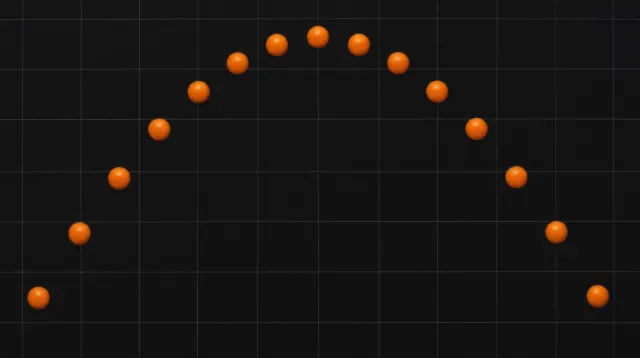
Projectile Motion: Formulas, Worked Example and Calculator
Projectile motion explained with a calculator: range, maximum height and time of flight formulas, a worked example and why 45 degrees gives the longest range.

Free fall explained with a calculator: time to fall, impact speed and distance fallen, the equations of motion with g = 9.81 m/s², examples and air resistance.

Drop a ball and it speeds up as it falls. Without air resistance, every object near Earth’s surface accelerates downward at the same rate: about 9.81 m/s².
Enter a drop height (starting from rest).
Starting from rest:
A stone dropped from 20 m: t = √(2 × 20 ÷ 9.81) ≈ 2.02 s; v = √(2 × 9.81 × 20) ≈ 19.8 m/s.
Without air resistance, no. A hammer and a feather fall together on the Moon, as Apollo 15 astronaut David Scott famously demonstrated in 1971.
In air, drag grows with speed until it balances weight, and the object stops accelerating: terminal velocity. A skydiver’s terminal velocity is very different from a raindrop’s.
Free fall is a special case of projectile motion; see our projectile motion calculator. For the energy view, see kinetic vs potential energy, and for the underlying law, Newton’s laws of motion.
About 9.81 m/s² near Earth’s surface, often rounded to 9.8 or 10 in exams.
Not in a vacuum. In air, differences come from air resistance, not mass alone.
The constant speed reached when air resistance balances the force of gravity.

Every article is edited by a human and checked against our editorial policy. Spotted a mistake? Tell us.
Projectile motion explained with a calculator: range, maximum height and time of flight formulas, a worked example and why 45 degrees gives the longest range.
Ohm’s law explained with a free calculator: V = IR, how to find voltage, current or resistance, power in circuits, worked examples and common mistakes.
Newton’s first, second and third laws of motion explained simply, with everyday examples, the F = ma formula, worked problems and common misconceptions.