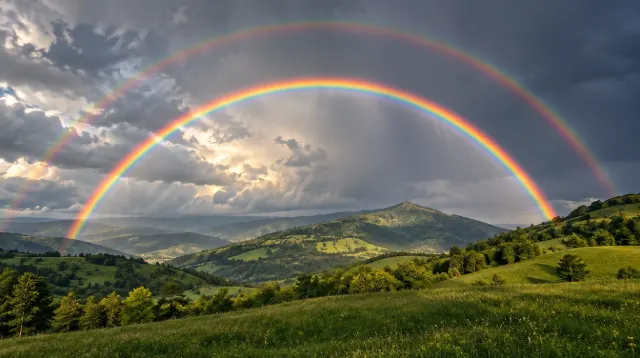
How Rainbows Form
How rainbows form: refraction, dispersion and reflection inside raindrops, why the colours appear in order, why rainbows are arcs and double rainbows.

Why the sky is blue, explained simply: how sunlight scatters off air molecules, why short wavelengths scatter more, red sunsets and why it isn’t violet.

It’s one of the oldest questions children ask, and the answer is a beautiful piece of physics. The sky is blue because of the way sunlight interacts with the tiny molecules of gas in our atmosphere, a process called Rayleigh scattering.
Sunlight looks white, but it is a mixture of all the colors of the rainbow, each with a different wavelength. A prism or a raindrop separates them by refraction, described by Snell’s law; the sky does it a different way, by scattering. Red light has the longest wavelengths in the visible spectrum, around 700 nanometres; blue and violet have the shortest, around 400–450 nanometres.
When light meets particles much smaller than its wavelength, such as the nitrogen and oxygen molecules in air, some of it is absorbed and re-emitted in all directions. This redirecting of light is called scattering.
Rayleigh scattering depends very strongly on wavelength. The amount of scattering is roughly proportional to 1 ÷ wavelength⁴. Because of that fourth power, halving the wavelength increases scattering sixteen times.
Blue light, with its short wavelength, is scattered several times more than red light. As sunlight passes through the atmosphere, blue light is scattered across the whole sky and reaches your eyes from every direction. Look anywhere away from the sun, and you see that scattered blue light.
Violet has an even shorter wavelength than blue, so it scatters even more. The sky isn’t violet for three reasons:
The result is the sky blue we see.
At sunrise and sunset, sunlight travels through far more atmosphere to reach you. Along that long path, most of the blue light is scattered out of the beam, leaving the longer wavelengths — yellow, orange and red — to reach your eyes. Dust, smoke and pollution can make sunsets even more vivid.
Light from near the horizon travels through more air, and gets scattered many times over, mixing the colors back towards white. That’s why the sky fades from deep blue overhead to pale blue near the horizon.
Scattered skylight is also partially polarized: its waves vibrate more in one direction than others. Polarized sunglasses exploit this to cut glare and deepen the blue of the sky. The same polarization physics is at the heart of every LCD screen; LCD Business explains how LCD screens use polarizers.
Deep, clear water looks blue for a slightly different reason: water itself absorbs red light a little more than blue, and the effect builds up over depth. A swimming pool that turns green, on the other hand, isn’t a physics puzzle at all; it’s usually algae.
Cloud droplets are much larger than air molecules. Larger particles scatter all visible wavelengths roughly equally, a process called Mie scattering, so clouds look white or grey.
| Rayleigh scattering | Mie scattering | |
|---|---|---|
| Particle size | Much smaller than the wavelength (air molecules) | Similar to or larger than the wavelength (droplets, dust) |
| Depends on wavelength? | Strongly (about 1 ÷ λ⁴) | Weakly |
| Result | Blue sky, red sunsets | White clouds, hazy skies |
During the day, Mars’s sky often looks butterscotch or reddish because of fine dust, while Martian sunsets can look bluish.
No. Without an atmosphere to scatter light, space looks black, even in daylight.
The explanation is named after Lord Rayleigh, the British physicist who described the scattering of light by small particles in the 19th century.

Every article is edited by a human and checked against our editorial policy. Spotted a mistake? Tell us.
How rainbows form: refraction, dispersion and reflection inside raindrops, why the colours appear in order, why rainbows are arcs and double rainbows.
Refraction and Snell’s law explained: why light bends between materials, refractive index, n₁ sin θ₁ = n₂ sin θ₂, total internal reflection and a calculator.
The Doppler effect explained: why a passing siren changes pitch, the formula, redshift and blueshift of light, and uses in radar, medicine and astronomy.