
The Electromagnetic Spectrum Explained
The electromagnetic spectrum explained: radio, microwaves, infrared, visible light, ultraviolet, X-rays and gamma rays, their wavelengths, uses and dangers.
Key takeaways
- All electromagnetic waves travel at the speed of light in a vacuum, about 300,000 km per second.
- From radio waves to gamma rays, wavelength gets shorter and frequency and energy get higher.
- Ultraviolet, X-rays and gamma rays are ionising at higher energies and can damage cells; radio waves and microwaves are not.
On this page
The electromagnetic spectrum is the full range of electromagnetic waves, from long radio waves to tiny, high-energy gamma rays. They’re all the same kind of wave, oscillating electric and magnetic fields, and they all travel at the speed of light in a vacuum: exactly 299,792,458 metres per second. What changes across the spectrum is wavelength and frequency. As wavelength gets shorter, frequency and the energy carried by each photon get higher. Visible light is only a thin slice in the middle.
The seven regions
Listed from longest wavelength (lowest frequency) to shortest (highest frequency). The boundaries are approximate and overlap.
| Region | Approximate wavelength | Common uses | Hazards |
|---|---|---|---|
| Radio waves | Longer than about 1 m | Broadcasting, communications, radar | Very low; non-ionising |
| Microwaves | About 1 mm to 1 m | Cooking, mobile phones, Wi-Fi, satellites | Heating at high power |
| Infrared | About 700 nm to 1 mm | Heaters, remote controls, thermal cameras, fibre optics | Burns from intense sources |
| Visible light | About 400 to 700 nm | Seeing, photography, lighting, lasers | Eye damage from very bright sources |
| Ultraviolet | About 10 to 400 nm | Sterilising, fluorescent lamps, security marks | Sunburn, eye damage, skin cancer risk |
| X-rays | About 0.01 to 10 nm | Medical imaging, airport security | Ionising: can damage cells and DNA |
| Gamma rays | Shorter than about 0.01 nm | Radiotherapy, sterilising equipment, astronomy | Ionising: can damage cells and DNA |
A handy memory aid for the order is “Red Monkeys In Vans Use X-ray Glasses”.
Wavelength, frequency and energy
All electromagnetic waves obey the wave equation:
c = f × λ
where c is the speed of light, f is frequency in hertz and λ is wavelength in metres. Because c is fixed, a shorter wavelength means a higher frequency. For example, Wi-Fi at 2.4 GHz has a wavelength of about 3 × 10⁸ ÷ 2.4 × 10⁹ = 0.125 m, or 12.5 cm. Try it with our wave speed calculator.
The energy of each photon is E = h × f, where h is Planck’s constant (about 6.63 × 10⁻³⁴ J s). Higher frequency means more energy per photon, which is why ultraviolet can burn skin while radio waves pass harmlessly through you.
Visible light and colour
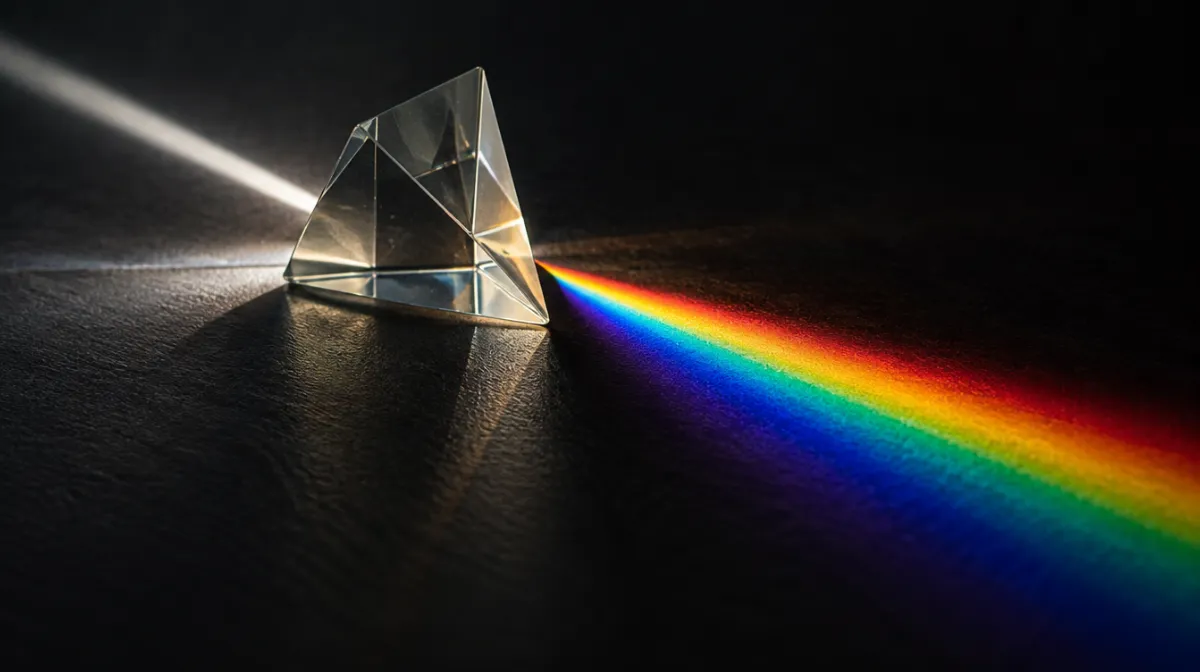
The visible spectrum runs from red (about 700 nm) through orange, yellow, green, blue and indigo to violet (about 400 nm). White light is a mixture of all of them, which a prism or raindrops can separate; see how rainbows form. Blue light scatters more in the atmosphere than red, which is why the sky is blue. Different wavelengths also bend by different amounts when they enter glass or water, explained in our guide to Snell’s law and refraction.
Ionising and non-ionising radiation
- Non-ionising: radio waves, microwaves, infrared and visible light don’t carry enough energy per photon to knock electrons from atoms. At high power they can heat tissue, which is why exposure limits exist. Everyday exposure from phones and Wi-Fi is well below international guideline limits.
- Ionising: higher-energy ultraviolet, X-rays and gamma rays can remove electrons from atoms, damaging cells and DNA. That’s why X-ray staff stand behind shields, why doses are kept as low as possible and why sun protection matters.
Using the spectrum safely
- UV: protect skin and eyes in strong sun, especially when the UV index is high.
- X-rays: medical X-rays use small doses where the benefit outweighs the risk; staff limit their own exposure with shielding and distance.
- Gamma rays: sources are shielded with lead or concrete and handled under strict rules.
- Lasers: never look into a laser beam, even a low-power pointer.
How the waves are produced
- Radio waves: electrons oscillating in an aerial
- Microwaves: electronic devices such as magnetrons in ovens
- Infrared: every warm object emits it; the hotter the object, the more it emits
- Visible and ultraviolet light: electrons changing energy levels in atoms, and very hot objects such as the Sun
- X-rays: fast electrons hitting a metal target
- Gamma rays: changes in atomic nuclei during radioactive decay; see half-life and radioactivity
Waves in astronomy
Astronomers observe the universe across the whole spectrum. Radio telescopes detect cold gas, infrared telescopes see through dust, and X-ray telescopes in space study black holes and exploding stars. The Earth’s atmosphere blocks most X-rays and gamma rays, so those telescopes must orbit above it. Motion also shifts the observed wavelength, the Doppler effect, which revealed that the universe is expanding.
Common mistakes
- Thinking some EM waves are faster than others in a vacuum. They all travel at the same speed.
- Confusing wavelength and frequency order. Radio has the longest wavelength and lowest frequency.
- Calling all radiation dangerous. Only ionising radiation carries the cell-damaging risks; the rest depends on intensity.
Frequently asked questions
Which electromagnetic wave has the highest energy?
Gamma rays, because they have the highest frequency and shortest wavelength.
Is visible light part of the electromagnetic spectrum?
Yes. It’s the narrow band our eyes can detect, between about 400 and 700 nanometres.
Are microwaves dangerous?
Microwaves are non-ionising. At high power they heat things, which is how microwave ovens cook food, but ovens are shielded and everyday exposure from phones and Wi-Fi is far below safety limits.
Sources

Every article is edited by a human and checked against our editorial policy. Spotted a mistake? Tell us.