
Half-Life and Radioactive Decay: Formula and Calculator
Half-life explained with a calculator: the decay formula, how much remains after any time, examples from carbon-14 to technetium-99m, uses and radiation safety.
Key takeaways
- Half-life is the time for half the radioactive nuclei in a sample, or its activity, to decay.
- The amount left is N = N₀ × (½)^(t ÷ T); after 10 half-lives, about 0.1% remains.
- Decay is random for each nucleus but predictable for large numbers, which makes half-lives useful for dating and medicine.
On this page
The half-life of a radioactive isotope is the time it takes for half of the unstable nuclei in a sample to decay, or equivalently for its activity to fall by half. After one half-life, 50% remains; after two, 25%; after three, 12.5%, and so on. Half-lives range from fractions of a second to billions of years, and each isotope’s half-life is fixed. The formula is N = N₀ × (½)^(t ÷ T), and the calculator below works out how much remains after any time.
The formula
- N = N₀ × (½)^(t ÷ T)
- N = amount remaining (number of nuclei, mass or activity)
- N₀ = starting amount
- t = time elapsed
- T = half-life, in the same time units as t
The number of half-lives that have passed is simply t ÷ T.
| Half-lives passed | Fraction remaining | Percentage remaining |
|---|---|---|
| 1 | ½ | 50% |
| 2 | ¼ | 25% |
| 3 | ⅛ | 12.5% |
| 4 | 1/16 | 6.25% |
| 5 | 1/32 | About 3.1% |
| 10 | 1/1,024 | About 0.1% |
Half-life calculator
Use the same time unit (seconds, hours, days or years) for the half-life and the elapsed time. Add a target percentage to find how long it takes to fall that far.
Half-life calculator
Enter a half-life and time.
Half-lives of some isotopes
| Isotope | Approximate half-life | Where it matters |
|---|---|---|
| Technetium-99m | About 6 hours | Medical imaging tracer |
| Radon-222 | About 3.8 days | Natural radioactive gas in homes |
| Iodine-131 | About 8 days | Thyroid treatment |
| Cobalt-60 | About 5.3 years | Radiotherapy and sterilising equipment |
| Caesium-137 | About 30 years | Nuclear fallout and industrial gauges |
| Americium-241 | About 430 years | Smoke detectors |
| Carbon-14 | About 5,730 years | Radiocarbon dating |
| Uranium-238 | About 4.5 billion years | Dating rocks and the age of the Earth |
Worked examples
- Mass remaining: 80 g of iodine-131 (half-life 8 days) after 24 days. That’s 24 ÷ 8 = 3 half-lives, so 80 → 40 → 20 → 10 g.
- Finding a half-life: a sample’s activity falls from 1,200 Bq to 150 Bq in 12 hours. 1,200 → 600 → 300 → 150 is 3 half-lives, so the half-life is 12 ÷ 3 = 4 hours.
- Radiocarbon dating: a bone has 25% of the carbon-14 found in living things. That’s 2 half-lives, so it’s about 2 × 5,730 ≈ 11,460 years old.
- Not a whole number: after 12 days, iodine-131 has passed 1.5 half-lives, leaving (½)^1.5 ≈ 35% of the original.
Why decay is random but predictable
Each unstable nucleus has a fixed chance of decaying in any given second, but there’s no way to know when a particular nucleus will decay. With billions of nuclei, though, the overall rate is very predictable, just as you can’t predict one coin toss but can predict that about half of a million tosses will be heads. Half-life is essentially unaffected by temperature, pressure or chemical form for practical purposes.
Measuring half-life
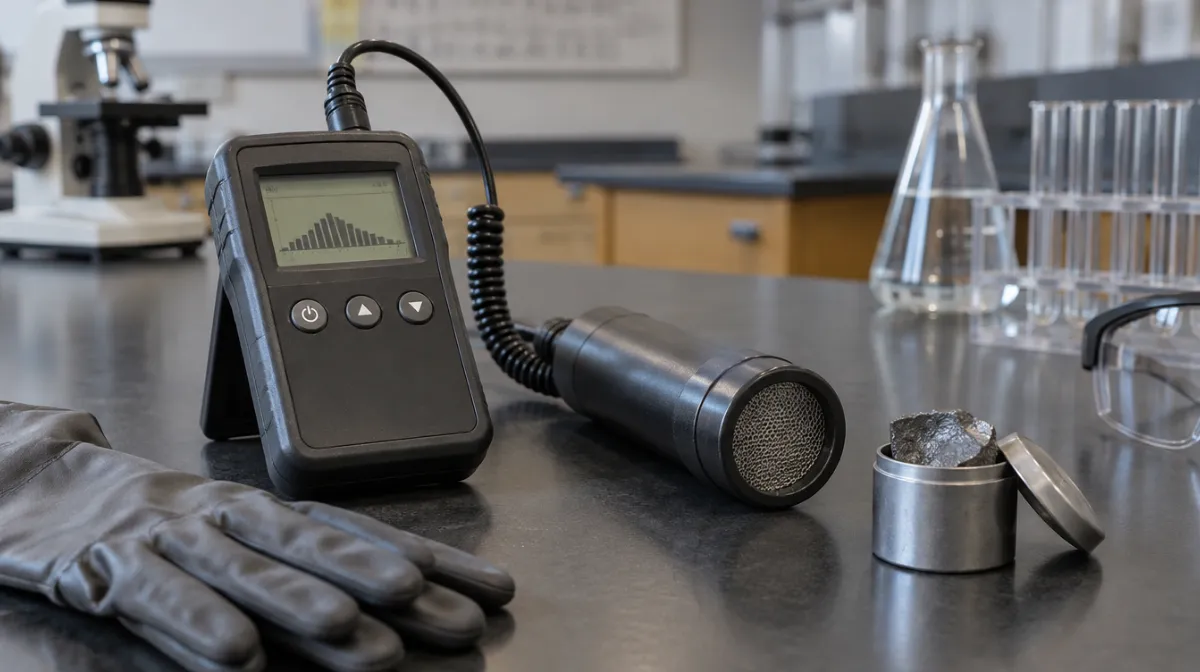
In the lab, a Geiger–Müller tube and counter record the count rate over time. Subtract the background count, which comes from natural sources around us, then plot count rate against time. The half-life is the time for the corrected count rate to halve, and it should be the same wherever you start on the curve.
Types of radiation
| Type | What it is | Stopped by | Ionising power |
|---|---|---|---|
| Alpha (α) | Two protons and two neutrons | A sheet of paper or a few centimetres of air | Strong |
| Beta (β) | A fast electron | A few millimetres of aluminium | Moderate |
| Gamma (γ) | High-energy electromagnetic radiation | Reduced by thick lead or concrete | Weak, but very penetrating |
Gamma rays sit at the high-energy end of the electromagnetic spectrum.
Why half-life matters in practice
- Medical tracers use short half-lives, such as technetium-99m, so the patient’s exposure is brief, but long enough to take images.
- Radiocarbon dating works for organic material up to roughly 50,000 years old; older samples have too little carbon-14 left to measure.
- Smoke detectors use americium-241, whose long half-life means the source lasts for the life of the detector.
- Nuclear waste with long half-lives must be stored safely for very long periods.
Radiation safety
Radiation dose depends on the type of radiation, the activity of the source, how long you’re exposed, how close you are and what shielding is in the way. Scientists minimise exposure by keeping time short, distance large and shielding in place. Contamination, where radioactive material gets on or into the body, is generally more serious than irradiation from an external source.
Most of our exposure comes from natural background radiation. In the UK, radon gas seeping from the ground is the largest source of natural radiation exposure for most people, and UKHSA provides guidance on testing homes in higher-radon areas.
Common mistakes
- Mixing time units, such as a half-life in days with elapsed time in hours.
- Thinking everything is gone after two half-lives. A quarter is still left.
- Subtracting instead of halving at each step.
- Forgetting background radiation in experiments.
See the physics formula sheet for other key equations, and our free fall calculator for another example of a physics calculator in action.
Frequently asked questions
Can the half-life of an isotope be changed?
Not by ordinary means. Heat, pressure and chemical reactions have essentially no effect on half-life.
Does a radioactive sample ever completely decay?
In theory the amount keeps halving, but in practice it becomes too small to detect after many half-lives.
What is the difference between half-life and activity?
Activity is the number of decays per second, measured in becquerels (Bq). Half-life is the time for that activity, or the number of undecayed nuclei, to halve.
Sources

Every article is edited by a human and checked against our editorial policy. Spotted a mistake? Tell us.