
Density: Formula and Calculator
Density explained with a free calculator: the formula ρ = m/V, units and conversions, densities of common materials, why things float and how to measure it.
Key takeaways
- Density is mass per unit volume: ρ = m ÷ V, measured in kg/m³ or g/cm³.
- Water’s density is about 1,000 kg/m³ (1 g/cm³); objects less dense than a fluid float in it.
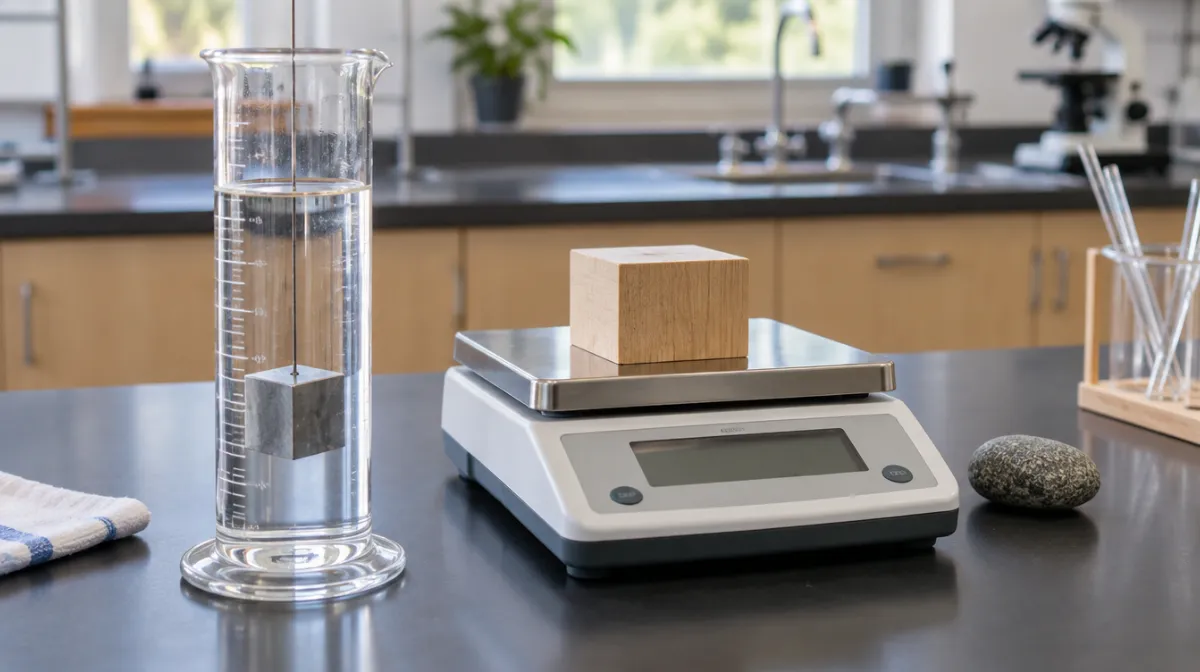
- Measure irregular objects by displacement: the rise in water level equals their volume.
On this page
Density tells you how much mass is packed into a given volume. The formula is ρ = m ÷ V, where ρ (the Greek letter rho) is density, m is mass and V is volume. In SI units, density is measured in kilograms per cubic metre (kg/m³); in the lab, grams per cubic centimetre (g/cm³) is common. Water has a density of about 1,000 kg/m³, or 1 g/cm³, which is why anything less dense floats in it. Use the calculator below to find density, mass or volume.
The density formula
- ρ = m ÷ V (density = mass ÷ volume)
- m = ρ × V (mass = density × volume)
- V = m ÷ ρ (volume = mass ÷ density)
Density calculator
Enter any two values; the third is calculated. Choose units for mass and volume.
Density calculator
Enter any two values.
Units and conversions
| From | To | Multiply by |
|---|---|---|
| g/cm³ | kg/m³ | 1,000 |
| kg/m³ | g/cm³ | 0.001 |
| g/mL | g/cm³ | 1 (they’re the same) |
| kg/L | kg/m³ | 1,000 |
Remember that 1 m³ = 1,000 litres = 1,000,000 cm³, and 1 mL = 1 cm³.
Densities of common materials
Values are approximate, at room temperature and normal pressure.
| Material | Density (kg/m³) | Density (g/cm³) |
|---|---|---|
| Air (sea level, 20°C) | About 1.2 | About 0.0012 |
| Cork | About 240 | About 0.24 |
| Oak wood | About 600 to 900 | About 0.6 to 0.9 |
| Ice | About 917 | About 0.92 |
| Pure water | About 1,000 | About 1.00 |
| Seawater | About 1,025 | About 1.03 |
| Aluminium | About 2,700 | About 2.70 |
| Iron | About 7,870 | About 7.87 |
| Copper | About 8,960 | About 8.96 |
| Lead | About 11,340 | About 11.34 |
| Gold | About 19,300 | About 19.3 |
Worked examples
- Find density: a metal block has a mass of 540 g and a volume of 200 cm³. ρ = 540 ÷ 200 = 2.7 g/cm³ = 2,700 kg/m³, which matches aluminium.
- Find mass: how much does 2 m³ of water weigh in kilograms? m = 1,000 × 2 = 2,000 kg.
- Find volume: what volume does 1 kg of gold occupy? V = 1 ÷ 19,300 ≈ 0.0000518 m³, about 51.8 cm³, smaller than a matchbox.
- Mixed units: a 250 mL bottle of oil has a mass of 230 g. ρ = 230 ÷ 250 = 0.92 g/cm³, so oil floats on water.
Why things float
An object floats if its average density is less than the density of the fluid it’s in. This is why ice (about 917 kg/m³) floats on water, why a steel ship floats (its hull encloses lots of air, so its average density is low) and why hot-air balloons rise (hot air is less dense than cooler air). The upward force is buoyancy, described by Archimedes’ principle: the buoyant force equals the weight of fluid displaced.
How to measure density
Regular shapes
- Measure the mass on a balance.
- Measure the length, width and height with a ruler, and calculate volume (for a cuboid, V = l × w × h).
- Divide mass by volume.
Irregular objects: the displacement method
- Measure the mass.
- Half-fill a measuring cylinder with water and read the volume.
- Lower the object in gently and read the new volume.
- The difference is the object’s volume. Divide mass by volume.
Liquids
Measure the mass of an empty measuring cylinder, add a known volume of liquid, measure again and subtract. Divide the liquid’s mass by its volume.
Density and temperature
Most materials expand when heated, so their density falls slightly. Water is unusual: it’s densest at about 4°C, and ice is less dense than liquid water. That’s why lakes freeze from the top down, protecting life below. Gases change density a lot with temperature and pressure; see our guide to pressure. Air’s density also falls with altitude: 5,000 metres up, it’s only about 60% of its sea-level value, which is why climbers get less oxygen with each breath.
Common mistakes
- Mixing units: grams with cubic metres, or kilograms with cubic centimetres.
- Forgetting 1 mL = 1 cm³ when using measuring cylinders.
- Reading the cylinder at an angle. Read the bottom of the meniscus at eye level.
- Confusing density with weight: a large block of wood can be heavier than a small piece of iron, but it’s still less dense.
For more formulas, see our physics formula sheet. Density also links to specific heat capacity, where the mass of a substance matters, and to momentum, where mass and velocity combine.
Frequently asked questions
What is the density of water?
About 1,000 kg/m³, or 1 g/cm³, at around 4°C. It’s very slightly lower at room temperature, about 998 kg/m³.
Is density the same as weight?
No. Weight is the force of gravity on an object’s mass. Density is mass per unit volume, a property of the material itself.
Why does a heavy ship float?
Because its average density, including the air inside the hull, is less than the density of water. It displaces a weight of water equal to its own weight.
Sources

Every article is edited by a human and checked against our editorial policy. Spotted a mistake? Tell us.