
Specific Heat Capacity: Formula and Calculator
Specific heat capacity explained with a calculator: Q = mcΔT, values for water and common materials, worked examples, the classic experiment and why it matters.
Key takeaways
- Specific heat capacity is the energy needed to raise 1 kg of a substance by 1°C.
- The equation is Q = m × c × ΔT; water’s value is about 4,200 J/kg°C, unusually high.
- High heat capacity explains why seas warm and cool slowly and why water is used for heating and cooling.
On this page
Specific heat capacity is the amount of energy needed to raise the temperature of 1 kilogram of a substance by 1 degree Celsius. The equation is Q = m × c × ΔT, where Q is energy in joules, m is mass in kilograms, c is specific heat capacity in joules per kilogram per degree Celsius (J/kg°C) and ΔT is the temperature change. Water has an unusually high value, about 4,200 J/kg°C, which is why it takes so long to boil a full kettle and why coastal climates are milder.
The equation
- Q = m × c × ΔT
- c = Q ÷ (m × ΔT)
- m = Q ÷ (c × ΔT)
- ΔT = Q ÷ (m × c)
A temperature change of 1°C is the same as a change of 1 kelvin, so J/kg°C and J/kg K are interchangeable here.
Specific heat capacity calculator
Enter any three values; the fourth is calculated. Pick a material to fill in its specific heat capacity.
Specific heat capacity calculator
Enter any three values.
Values for common materials
Approximate values near room temperature. Exam boards often round water to 4,200 J/kg°C.
| Material | Specific heat capacity (J/kg°C) |
|---|---|
| Water | About 4,186 |
| Ice | About 2,100 |
| Olive oil | About 1,970 |
| Air (at constant pressure) | About 1,005 |
| Aluminium | About 900 |
| Glass | About 840 |
| Iron | About 450 |
| Copper | About 385 |
| Lead | About 130 |
Worked examples
- Boiling water: how much energy heats 2 kg of water from 20°C to 100°C? Q = 2 × 4,186 × 80 = 669,760 J, about 670 kJ. A 3 kW kettle supplies 3,000 J every second, so this takes about 670,000 ÷ 3,000 ≈ 223 seconds, just under four minutes, ignoring heat losses.
- Find the temperature rise: 45,000 J is supplied to 1 kg of aluminium. ΔT = 45,000 ÷ (1 × 900) = 50°C.
- Find c: 7,700 J raises 0.5 kg of a metal by 40°C. c = 7,700 ÷ (0.5 × 40) = 385 J/kg°C, which matches copper.
- Why pans heat fast: 1 kg of copper needs only 385 J per degree, about a tenth of water’s value, so a copper pan heats up much more quickly than the water inside it.
The classic experiment
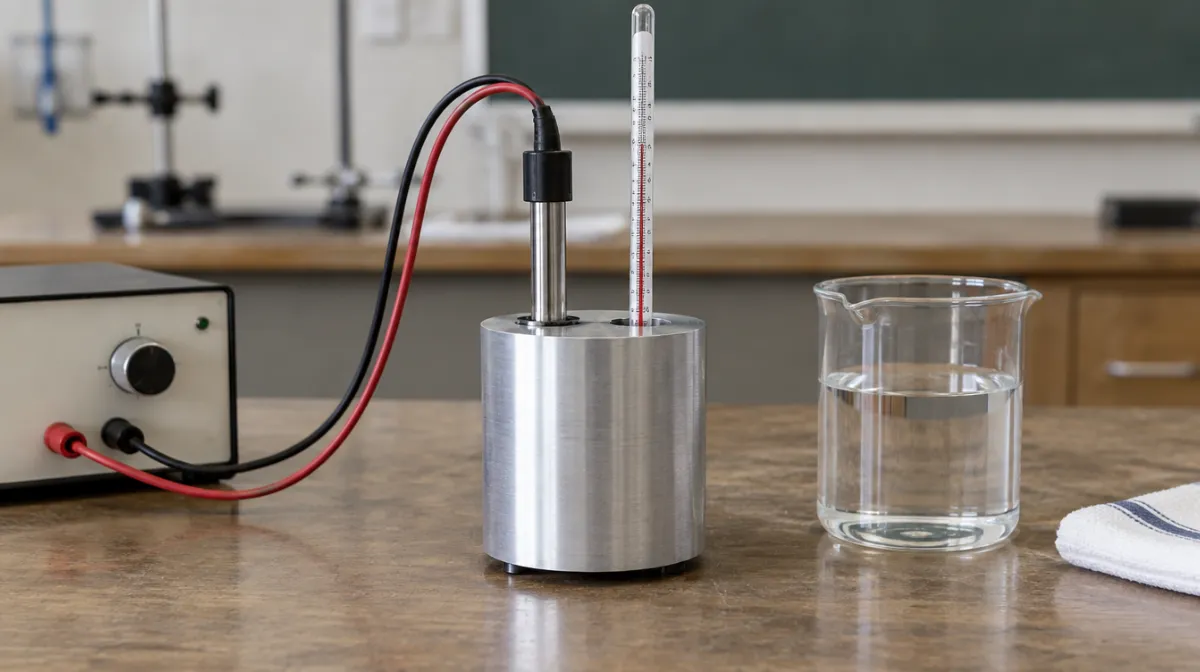
A common school practical measures the specific heat capacity of a metal block:
- Measure the block’s mass.
- Insert an electric heater and a thermometer into holes in the block, and wrap it in insulation.
- Record the starting temperature, switch on the heater and measure the energy supplied with a joulemeter, or calculate it from power × time (E = P × t) or voltage × current × time (E = V × I × t).
- Record the temperature rise after a set time.
- Calculate c = E ÷ (m × ΔT).
Results are usually a little higher than textbook values because some energy escapes to the surroundings. Better insulation and a drop of oil in the thermometer hole improve accuracy. Our Ohm’s law calculator helps with the electrical side.
Why it matters
- Climate: oceans absorb huge amounts of energy with small temperature changes, which keeps coastal climates milder than inland ones.
- Heating and cooling: water’s high value makes it ideal for radiators, hot-water bottles and engine cooling systems.
- Cooking: oil heats faster than water because its specific heat capacity is lower.
- Storage heaters: dense materials store energy overnight and release it slowly.
Heat capacity in the kitchen and at home
A jacket potato stays hot long after its foil has cooled, because the potato is mostly water and stores far more energy per degree than thin aluminium. Hot-water bottles use the same idea. Materials with a low specific heat capacity, such as metals, heat up and cool down quickly.
A common confusion: a metal bench feels colder than a wooden one at the same temperature because metal conducts heat away from your hand faster. That’s thermal conductivity, not specific heat capacity.
Heat capacity vs latent heat
Specific heat capacity describes energy that changes temperature. When a substance melts or boils, energy goes into changing state instead, and the temperature stays constant. That’s specific latent heat, calculated with Q = m × L. Heating ice from −10°C to steam at 100°C involves both.
Energy transfers like these are part of the wider picture in work, energy and power. Density also plays a part in heating systems; see our density calculator.
Common mistakes
- Using grams instead of kilograms. 500 g is 0.5 kg.
- Using the final temperature instead of the change. ΔT is final minus initial.
- Mixing kJ and J. Keep everything in joules.
- Forgetting heat losses when comparing experimental results with textbook values.
Frequently asked questions
Why does water have a high specific heat capacity?
Hydrogen bonds between water molecules absorb a lot of energy before the molecules move faster, so more energy is needed to raise the temperature.
What is the specific heat capacity of water?
About 4,186 J/kg°C. Many exams use 4,200 J/kg°C.
Is specific heat capacity the same as heat capacity?
No. Heat capacity is for a whole object; specific heat capacity is per kilogram of the material.
Sources

Every article is edited by a human and checked against our editorial policy. Spotted a mistake? Tell us.