
Pressure Explained: Formula, Units and Examples
Pressure explained: the formula p = F/A, pascals and other units, pressure in liquids (p = ρgh), atmospheric pressure, hydraulics and everyday examples.
Key takeaways
- Pressure is force per unit area: p = F ÷ A, measured in pascals (1 Pa = 1 N/m²).
- In a liquid, pressure increases with depth: p = ρgh.
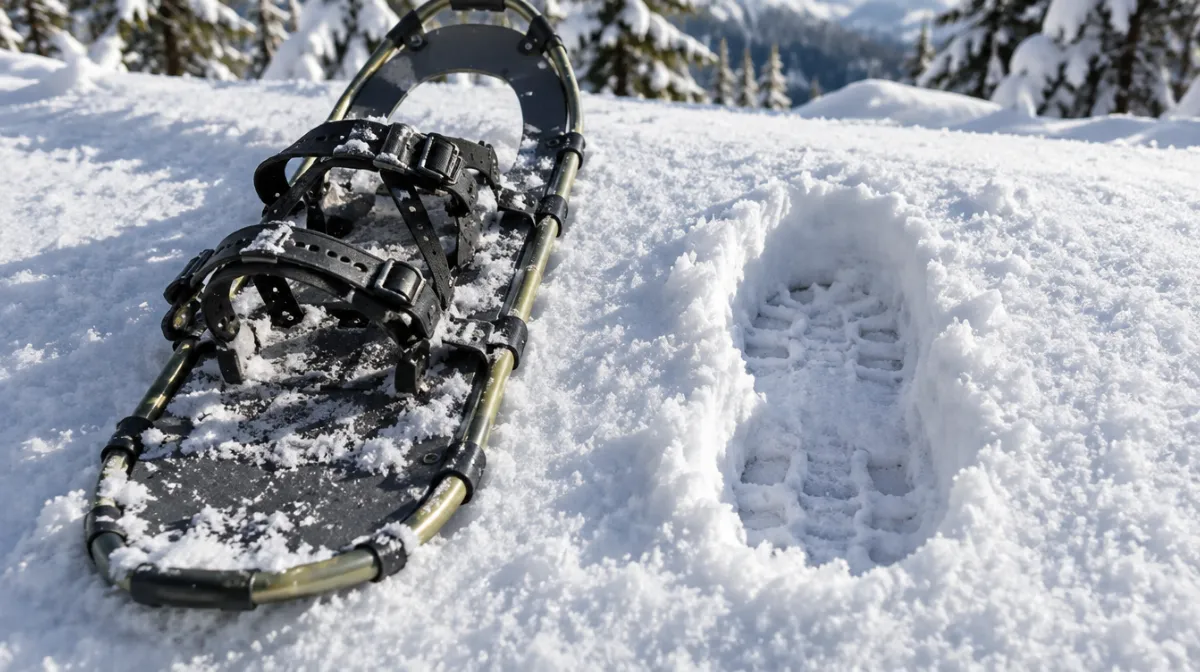
- Spreading a force over a bigger area lowers the pressure, which is why snowshoes work and knives are sharpened.
On this page
Pressure is how concentrated a force is: the force acting on each unit of area. The formula is p = F ÷ A, where p is pressure in pascals (Pa), F is force in newtons (N) and A is area in square metres (m²). One pascal is one newton per square metre, which is tiny, so pressures are often given in kilopascals (kPa). The same force produces a higher pressure on a smaller area, which is why a sharp knife cuts and why snowshoes stop you sinking.
The pressure formula
- p = F ÷ A (pressure = force ÷ area)
- F = p × A
- A = F ÷ p
Worked examples
- Standing person: a 60 kg person weighs about 60 × 9.81 = 589 N. If both feet cover 0.04 m², the pressure is 589 ÷ 0.04 ≈ 14,700 Pa (14.7 kPa).
- On snowshoes: with snowshoes covering 0.4 m², the pressure drops to 589 ÷ 0.4 ≈ 1,470 Pa, ten times less, so they sink far less.
- Drawing pin: pushing with 10 N on a pin point of 0.0000001 m² (0.1 mm²) gives 10 ÷ 0.0000001 = 100,000,000 Pa (100 MPa), enough to pierce wood. The flat head spreads the same force over your thumb.
Units of pressure
| Unit | Equals | Where you’ll see it |
|---|---|---|
| Pascal (Pa) | 1 N/m² | SI unit, physics |
| Kilopascal (kPa) | 1,000 Pa | Engineering, tyre pressures in some countries |
| Bar | 100,000 Pa | Weather, diving, industry |
| Atmosphere (atm) | 101,325 Pa | Chemistry and standard conditions |
| Millibar or hectopascal (hPa) | 100 Pa | Weather maps |
| Pounds per square inch (psi) | About 6,895 Pa | Tyres in the UK and US |
| Millimetres of mercury (mmHg) | About 133.3 Pa | Blood pressure |
Pressure in liquids
In a liquid, pressure increases with depth because of the weight of liquid above. The formula is:
p = ρ × g × h
where ρ is the liquid’s density in kg/m³, g is gravitational field strength (9.81 N/kg on Earth) and h is depth in metres. Pressure at a given depth acts equally in all directions and doesn’t depend on the shape of the container.
Example: at 10 m deep in seawater (ρ ≈ 1,025 kg/m³), the extra pressure is 1,025 × 9.81 × 10 ≈ 100,600 Pa, about one atmosphere. A diver at 10 m therefore feels about twice the pressure at the surface. Our density calculator has densities for other liquids.
Atmospheric pressure
Air has weight too. At sea level, the atmosphere presses down with an average pressure of about 101,325 Pa (1,013 hPa). It decreases with altitude because there’s less air above you, which is why your ears pop in a plane or on a mountain road. Weather systems show small changes: high pressure usually brings settled weather, low pressure unsettled weather.
We don’t feel crushed because the fluids in our bodies push outwards with the same pressure.
Gauge and absolute pressure
- Absolute pressure is measured from a perfect vacuum.
- Gauge pressure is measured relative to atmospheric pressure. A tyre gauge reading 2.2 bar means about 2.2 bar above the surrounding air, or roughly 3.2 bar absolute.
Hydraulics: multiplying force
Liquids are almost incompressible, and pressure applied to an enclosed liquid is transmitted equally throughout it (Pascal’s principle). A small force on a small piston creates a pressure that acts on a large piston, producing a larger force:
F₂ = F₁ × (A₂ ÷ A₁)
If a 100 N force acts on a piston of 0.01 m², the pressure is 10,000 Pa. On a piston of 0.5 m², that pressure produces 5,000 N. Car brakes, hydraulic jacks and diggers all use this. The trade-off is distance: the small piston must move much further than the large one, so no energy is created; see work, energy and power.
Everyday examples
| Situation | High or low pressure? | Why |
|---|---|---|
| Sharp knife | High | Tiny edge area concentrates the force |
| Snowshoes and wide tyres | Low | Large area spreads the weight |
| Stiletto heels | Very high | Small heel area can dent floors |
| Tractor tyres | Low | Wide tyres stop heavy machines sinking into fields |
| Dam walls | Thicker at the bottom | Water pressure increases with depth |
Off-road drivers lower tyre pressure on soft sand for the same reason: a longer, wider contact patch spreads the vehicle’s weight. Our sister site covers choosing all-terrain tyres for sand driving.
Pressure in gases
Gas pressure comes from molecules colliding with the walls of their container. Heating a gas in a sealed container makes molecules move faster and hit harder and more often, so pressure rises. Squashing a gas into a smaller volume at the same temperature also increases pressure (Boyle’s law: p × V stays constant). Our guide to kinetic and potential energy explains the energy of moving particles.
Common mistakes
- Using cm² instead of m². 1 m² = 10,000 cm², so divide cm² by 10,000.
- Using mass instead of weight. Convert kilograms to newtons with W = m × g.
- Forgetting gauge pressure when comparing tyre readings with absolute values.
Frequently asked questions
What is the unit of pressure?
The pascal (Pa), equal to one newton per square metre. Kilopascals, bar and psi are also common.
Why does pressure increase with depth?
Because there’s more fluid above pressing down. In a liquid, pressure rises in proportion to depth: p = ρgh.
Why do your ears pop when you fly?
Air pressure falls as you climb and rises as you descend. Your ears pop as pressure inside them equalises with the cabin.
Sources

Every article is edited by a human and checked against our editorial policy. Spotted a mistake? Tell us.