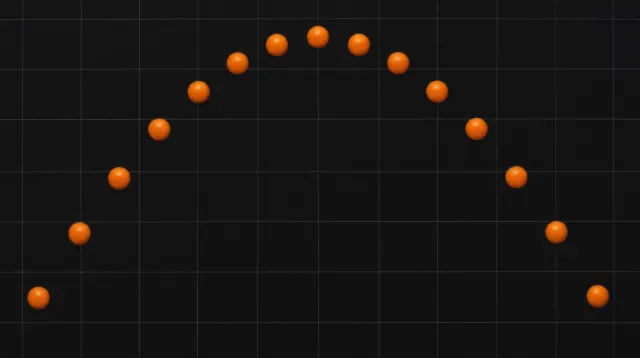
Newton’s Three Laws of Motion, Explained With Everyday Examples
Newton’s first, second and third laws of motion explained simply, with everyday examples, the F = ma formula, worked problems and common misconceptions.

A printable physics formula sheet: motion, forces, energy, momentum, circular motion, waves, electricity and light, with symbols, units and worked guides.
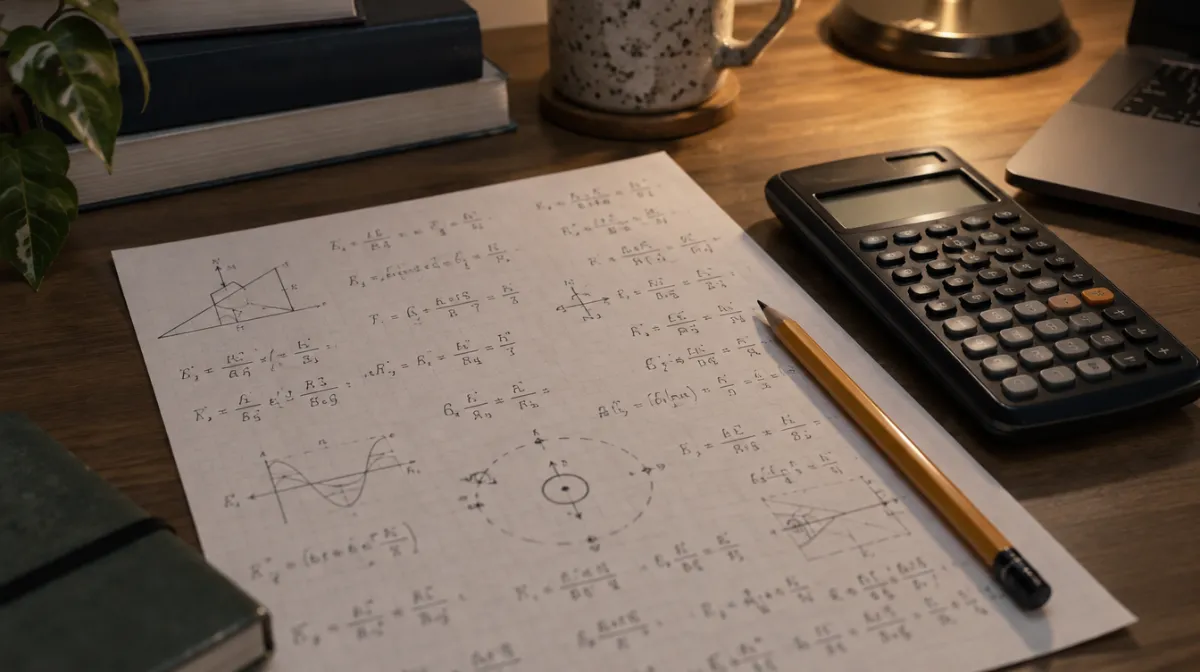
This sheet collects the core formulas most physics courses use. Always check your own exam board’s formula sheet and notation.
| Formula | Meaning |
|---|---|
| v = d/t | Speed = distance ÷ time |
| a = (v − u)/t | Acceleration |
| v = u + at | Final velocity |
| s = ut + ½at² | Displacement |
| v² = u² + 2as | Velocity–displacement |
Guides: speed, velocity and acceleration, projectile motion, free fall.
| Formula | Meaning |
|---|---|
| F = ma | Newton’s second law |
| W = mg | Weight |
| F = μN | Friction |
| p = mv | Momentum |
| FΔt = Δp | Impulse |
| F = mv²/r | Centripetal force |
Guides: Newton’s laws, momentum, friction, centripetal force.
| Formula | Meaning |
|---|---|
| KE = ½mv² | Kinetic energy |
| PE = mgh | Gravitational potential energy |
| W = Fd | Work |
| P = W/t | Power |
Guides: kinetic vs potential energy, work, energy and power.
| Formula | Meaning |
|---|---|
| V = IR | Ohm’s law |
| P = VI | Electrical power |
Guide: Ohm’s law calculator.
| Formula | Meaning |
|---|---|
| v = fλ | Wave speed |
| n₁ sin θ₁ = n₂ sin θ₂ | Snell’s law |
Guides: Snell’s law, Doppler effect, rainbows.
Check your exam board; some provide formula sheets and others require memorisation.
F = ma underpins much of mechanics, but each topic has its key equations.
Understand what they mean, use them in problems regularly and make your own summary sheet.

Every article is edited by a human and checked against our editorial policy. Spotted a mistake? Tell us.
Newton’s first, second and third laws of motion explained simply, with everyday examples, the F = ma formula, worked problems and common misconceptions.
Projectile motion explained with a calculator: range, maximum height and time of flight formulas, a worked example and why 45 degrees gives the longest range.
Why the sky is blue, explained simply: how sunlight scatters off air molecules, why short wavelengths scatter more, red sunsets and why it isn’t violet.